Work gear by sector in Colombia 2026: construction, healthcare and retail
How mandatory work gear changes in Colombia 2026 by sector: construction, healthcare, retail, services, and logistics. Industry guide with what cannot be missing.
Contents
In Colombia, the work gear and uniforms law is the same for every company: three annual deliveries (April, August, December) to employees earning up to two SMMLV, footwear and work attire appropriate for the activity. That part does not change in 2026.
What does change is what "appropriate for the activity" means in each sector. A construction worker, a nursing assistant, a retail associate, and a delivery driver don't receive the same gear —and confusing them generates real non-compliance, not just cosmetic ones—. This guide goes sector by sector, with the minimum required and what, from operational experience, is worth adding even if the regulation doesn't ask for it.
If you still need the general framework of the law —who it applies to, when to deliver, what happens if it is not met—, start with our guide to work gear in Colombia. This note assumes you already have that framework clear and goes straight to how you apply it based on your industry.
The legal framework in 90 seconds
Article 230 of the CST requires the employer to deliver, three times a year (last business day of April, August, and December), a pair of shoes and a work outfit to the employee who has worked at least three months and earns up to two SMMLV.
Points often overlooked:
- Work gear is additional to salary: it is not deducted or offset with money.
- It is personal and non-transferable: it is not delivered to the group "to share".
- The employee is required to use it at work. Not wearing it is grounds for a written warning.
- For roles requiring personal protective equipment (PPE), these are additional to common work gear and are required by Resolution 2400 of 1979 and specific ARL regulations.
The important thing for your company: the law defines the minimum, the sector defines the real standard. A retail uniform "complies with the law" but doesn't work for you if your brand policy requires an embroidered polo. A generic coverall "complies with the law" but doesn't work if your worker is at heights. The real operational criterion is what gear the employee needs to do their job well and safely.
Work gear in construction: PPE + uniform + high rotation
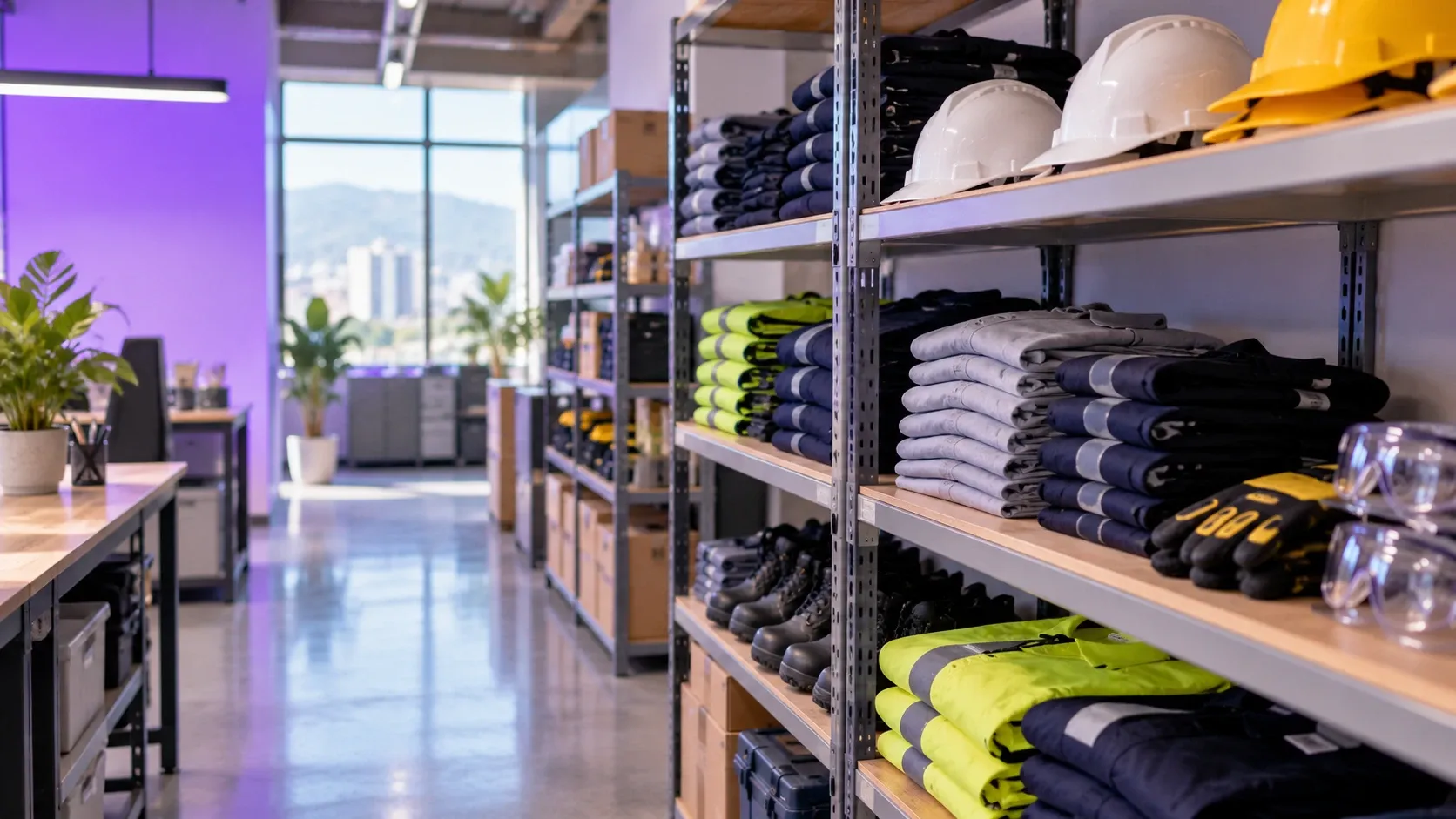
Construction is the sector where work gear has the heaviest operational weight (and the biggest risk if it fails). What can't be missing:
Work attire:
- Reinforced cargo pants or industrial jeans
- Long-sleeve shirt (sun protection + cuts)
- Reflective vest (visibility on-site)
- Coverall for workers in "dirty" sites (mixing, demolition, excavation)
Footwear:
- Safety boots with steel or composite toe, slip-resistant sole, hydrocarbon resistant.
- For wet-terrain work: rubber boots with toe cap.
PPE (mandatory, additional):
- Class B safety helmet (with suspension in good condition)
- Gloves per task (leather for masonry, nitrile for chemicals, dielectric for electricity)
- Safety goggles
- Hearing protection in areas with noise >85 dB
- Harness and lifeline for height work (>1.5 m)
- N95 mask in areas with particulate material
Operational: on-site rotation is high and coveralls wear out quickly. Two annual deliveries by regulation often fall short in reality. The companies that do it well have an extraordinary wear-and-tear replacement system (against return of the old item) without waiting for next April.
Cases from companies like Habi show that when the sector involves field + office, multi-profile gear management is part of day-to-day work and needs process, not improvisation.
Work gear in healthcare: scrubs, fluid-resistant footwear, and biosecurity
The healthcare sector in Colombia has its own regulatory layer (Resolution 3100 of 2019, Ley 100, licensing requirements) on top of Article 230 of the CST. The minimum acceptable for assistants, nurses, and clinical staff earning up to two SMMLV:
Work attire:
- Medical scrubs (fluid-resistant uniform, two-piece) with embroidery or institutional insignia
- Surgical gown in areas that require it
- Fabric cap in services where applicable
- Institutional jacket for cold areas
Footwear:
- Closed, non-slip, fluid-resistant shoe, made of a material that allows disinfection (preferably white or institutional color)
- For high biological-risk areas: specific footwear that withstands autoclave or deep disinfection
PPE + biosecurity (additional):
- Exam gloves (nitrile or latex) for frequent use
- Standard surgical mask + N95 depending on service
- Goggles or face shield in services with splash risk
- Plastic apron in specific procedures
Operational: fluid-resistant footwear degrades quickly with constant disinfection. In well-managed healthcare institutions, the real cycle is replacement every 4-6 months, not twice a year. It is worth separating budget-wise the gear by regulation (3 deliveries) from biosecurity spending (continuous) to avoid cash flow issues in the months without official delivery.
Work gear in retail: uniform + brand image
Retail (supermarkets, stores, big-box, pharmacies) has a distinctive characteristic: the gear fulfills two functions at once: a labor benefit required by law AND a brand uniform facing the customer. This creates operational complications the other sectors don't have.
Work attire:
- Institutional polo or shirt with embroidered logo
- Pants or skirt in corporate color
- Vest or specific apron (per role: cashier, stocker, customer service)
- Scarf or band in some formats
Footwear:
- Closed, non-slip shoe (retail floors tend to be smooth and with spills). Usually classic black.
- For warehouse/receiving staff: footwear with toe cap.
PPE (per role):
- Back support belt for stockers and loaders
- Cut-resistant gloves for deli and meat
- Helmet in high warehouse zones
What is tricky about retail:
- Wide sizes and varieties (more women employees than in construction, broader body-type variety, adolescent sizes for teen shifts in some formats).
- High employee turnover: a typical store rotates a significant percentage of the team every year. Each new hire means new gear outside the April/August/December cycle.
- Brand consistency across stores: the shirt in Bogotá has to be the same as in Medellín.
- Wear replacement facing the customer: a stained shirt cannot be worn even if "it still works".
It is the sector where most companies lose control of gear spending due to a mix of physical inventory + constant replacement + different providers by region.
Work gear in services and hospitality
For cleaning, maintenance, security, hospitality, and restaurant services, the gear tends to be lighter than in construction but with higher personal presentation requirements.
Work attire by sub-sector:
- Cleaning and maintenance: coverall or pajama in institutional color, apron.
- Security and reception: institutional shirt or guayabera, pants, outerwear jacket.
- Hospitality (front desk, housekeeping, bellhop): more formal uniform, with variations by shift.
- Restaurants (kitchen and service): chef jacket, apron, non-slip chef pants; for customer service, shirt + vest or short apron.
Footwear:
- Closed, non-slip, comfortable shoe (many hours on feet).
- For kitchen: non-slip and fluid-resistant footwear.
- For security and reception: classic black shoe.
PPE:
- Nitrile gloves for cleaning with chemicals
- Mask in high-risk service areas
- Face mask and cap in food handling
Operational: this is the sector where it is most worth standardizing providers because stores and hotels usually have multiple locations with the same uniform need. Buying by volume lowers cost per employee and speeds up replacements.
Work gear in logistics and transportation
Logistics operators, delivery drivers, and distribution centers combine part of the construction profile (PPE, safety footwear) with part of the services profile (customer-facing image, consistent uniform).
Work attire:
- Reinforced cargo pants
- Long-sleeve shirt or polo with logo
- Reflective vest (mandatory for urban delivery)
- Institutional jacket + rain gear (for drivers)
Footwear:
- Safety shoe or boot with toe cap.
- For drivers: comfortable, non-slip shoe.
PPE:
- Back support belt for loaders
- Helmet in high distribution center
- Cut-resistant and load gloves
- For motorcycle/bike drivers: certified helmet, knee pads, gloves.
Operational: this is the sector where the employee's vehicle also gets "equipped" —helmets, boxes, vehicle rain gear—. These items are not work gear in the sense of Article 230 but are part of the package the company provides and are worth managing together.
How to manage multi-sector gear without losing your mind
If your company operates in a single sector, work gear is a manageable process: one large purchase every four months, a central warehouse, an HR lead who does the size matching.
The real pain starts when several variables appear simultaneously:
- Multiple sectors within the same company (plant + office + delivery).
- Multiple locations with different regional sizes and providers.
- High turnover: hires and exits outside the official cycle that require extra gear.
- Broad sizes and varieties: men and women, coveralls and formal uniforms, non-slip and safety.
- Unscheduled wear replacement.
The typical result: outdated sizes spreadsheet, physical inventory that doesn't match HR, duplicate purchases, employees complaining that "my gear never arrived".
Several companies in Colombia today move the management to integrated benefits platforms that operate as a "digital catalog": the employee enters the app, chooses the right sizes of their gear (boot, pants, shirt) from a pre-approved catalog by HR, places the order, and the provider ships to the employee's address or to the site. HR stops managing physical inventory and starts approving a digital flow.
The advantage is not just operational: it removes the friction of "when does my gear arrive?" from the employee. In high-turnover sectors —construction, retail, logistics— that friction translates into HR complaints that consume hours.
Maslow works with Colombian companies that operate in multiple sectors simultaneously (business group with plant + office + channel). The benefit is that the employee has a single app where they receive gear, flexible benefits, discounts, and recognition, and HR has a single panel to see what each one received and when the next delivery is due.
Frequently asked questions
Is work gear the same for every sector in Colombia in 2026?
Legally, the obligation is the same (three annual deliveries of footwear and work attire to employees earning up to two SMMLV). But the specific type of gear changes by sector: construction requires PPE and safety boots, healthcare requires fluid-resistant and biosecurity, retail prioritizes institutional uniform, logistics combines safety and image.
Is PPE part of the work gear?
No, it is additional. Work gear complies with Article 230 of the CST. PPE complies with Resolution 2400 of 1979 and sector-specific regulations (ARL). Both are mandatory but are recorded and budgeted separately.
What happens if the employee refuses to wear the work gear?
It is grounds for a written warning per Article 233 of the CST. The gear is for mandatory use during the workday. If repeated, it can escalate to disciplinary sanction per the internal regulation.
Can I deliver the work gear as cash equivalent?
No. The law requires delivering the physical items, not their monetary value. Paying instead of delivering is non-compliance and the company is exposed to sanction by the Ministry of Labor.
How do I handle work gear for employees joining outside the April/August/December cycle?
The law requires the employee to meet at least three months of service before the first delivery. If they join in May, their first gear is August's. Good practice: deliver a welcome initial gear (at least the uniform with logo + basic footwear) from day 1, even as an advance against the first legal delivery.
---
Want to simplify work gear administration at a company with multiple sectors and sites? Schedule a conversation with a Maslow specialist at maslow.hr/en/contact and we will show you how HR teams in Colombia manage it today.