Recognition management
Daily recognition strengthens bonds, reinforces values and builds a sense of belonging. With maslow, people can recognize each other simply and aligned with the culture your company wants to promote.
They choose us























What is an employee recognition program?
A recognition program is a structured system for the company to value each employee's contribution frequently, specifically, and visibly, making great work visible across the organization. Unlike annual reviews or year-end bonuses, modern recognition is continuous, peer-to-peer, and connected to company values. It is the retention lever with the best cost-to-impact ratio: Gallup studies show that companies with sustained recognition reduce voluntary turnover of their top talent by up to 45%.
- Peer-to-peer recognition: anyone on the team can recognize another, not just the manager.
- Points, stars, or badges redeemable for real rewards that the employee chooses.
- Custom cultural pillars: recognitions reinforce the values the company defines.
- Leader dashboard: visibility of who recognizes, who receives, who remains invisible.
Dato de mercado
Companies with frequent peer-to-peer recognition are 2.7x more likely to report high engagement in their teams (source: Gallup + Workhuman, 2024 longitudinal study).
Why is a recognition program a strategic necessity?
Recognition directly impacts motivation, retention and team performance. When people feel seen and appreciated, they don't just stay: they commit, collaborate and perform better.
Of people who quit a job do so because they don't feel recognized
Productivity increase possible with employees who feel happy
Send recognitions!
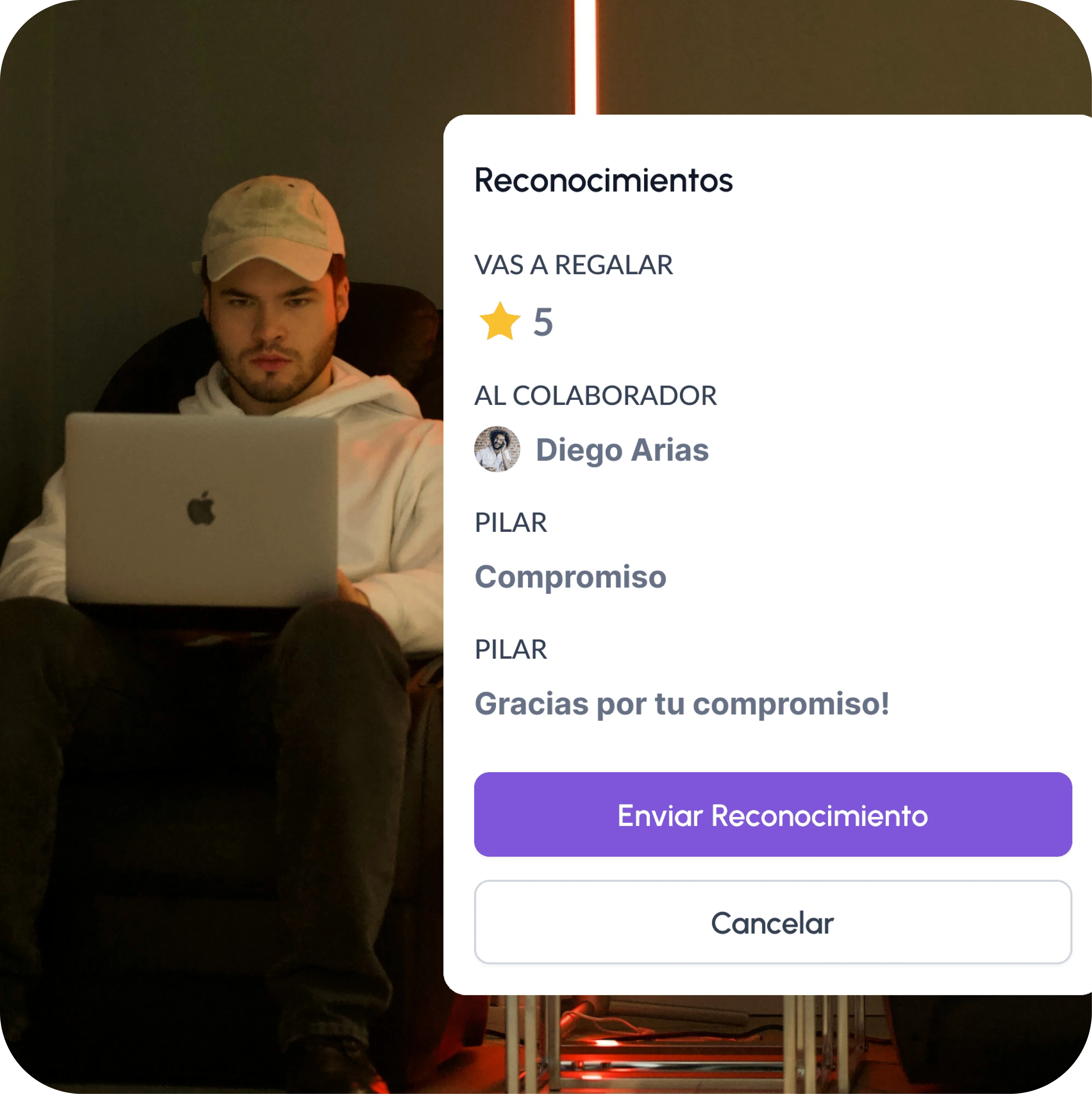
Did someone go the extra mile this month? Send them a recognition star!
 ⭐
⭐ ⭐⭐
⭐⭐ ⭐
⭐You have left: 5 ⭐
Without a program, recognition is left to chance
When recognizing achievements depends on each leader's goodwill, the result is uneven and hard to sustain:
- Recognition depends on each leader's style: some do it often, others almost never
- Without data, HR can't measure the climate or spot disengaged teams in time
- Achievements are celebrated in the moment and forgotten: they leave no mark on culture
- When people don't feel valued, turnover rises and replacing talent is expensive
Most recognized pillars
With maslow's recognition management
Recognition is peer-to-peer: any employee can recognize another in seconds
Option to send recognitions anonymously — useful for feedback that gains value without a name attached
Employees can transfer their own credits as a spontaneous gesture of appreciation
Each recognition can be aligned to customized categories and values
Recognition is visible, shared and measurable at team and organization level
Positive interactions stay alive, even in hybrid and remote teams
A recognition program is a strategic necessity
Greater engagement and sense of belonging
Frequent recognition strengthens the emotional bond with the company.
Living culture, even in distributed teams
Positive interactions connect people beyond role or location.
Constant reinforcement of values
Values are lived through concrete actions, not just presentations.
Clear information on climate and participation
Real data to support People and leadership decisions.
Zero additional operational burden for HR
Culture is strengthened from the team itself, without manual processes.
How does the recognition program work?
Recognize achievements simply and measurably, in 4 steps.
You configure values and recognition types
Define the behaviors to highlight and how they are recognized: peer-to-peer, manager-to-employee or by milestones.
Anyone recognizes a colleague
From the app, in seconds, tying the recognition to a company value. Visible to the whole team.
Points are redeemed for real benefits
Recognition earns points the team member uses across the benefits catalog, gift cards and discounts.
You measure engagement and culture with data
Reports on participation, most-recognized values and most active areas to strengthen culture with evidence.
Recognizing for real vs. recognizing when someone remembers
The difference between leaving recognition to chance and having a real program:
Informal recognition
Depends on each leader remembering to do it
No record or history of what was recognized
Celebrated in the moment and forgotten
Recognition isn't tied to any reward
Impossible to measure the impact on culture
Recognition program with Maslow
Anyone recognizes anyone, aligned with company values
Recognition history visible to the whole team
Recognition earns points redeemable for benefits
Redeem across the benefits catalog, gift cards and discounts
Reports on participation, values and most active areas
Companies using it
View all →

Lottus Education
Education
How Lottus Education builds its EVP for faculty and staff across a multi-brand operation
Read case →

Cashea
Finance & Banking
How Cashea professionalizes sales force incentives in a high-velocity fintech operation
Read case →

GOcuotas
Finance & Banking
How GOcuotas simplified benefits management and gained operational efficiency with maslow
Read case →Frequently asked questions
Typical LATAM cost: USD 5 to USD 15 per employee per month, split between platform (USD 2-5) + redeemable reward budget (USD 3-10). For a 100-employee company: USD 6k to USD 18k per year. Compared to the cost of 1 typical turnover (USD 24k), the program pays for itself by avoiding a single preventable turnover per year.
Top-down recognition is given by the leader to the employee (hierarchical, periodic). Peer-to-peer can be given by anyone on the team to another (horizontal, frequent). Modern programs combine both: top-down for formal milestones (promotion, bonus) and peer-to-peer for daily behavior. P2P programs have better ROI because they recognize 10-50x more events.
4 key metrics: coverage (% of employees who received at least one recognition per month), frequency (recognitions per employee per month), giver diversity (% of employees who recognized another), and correlation with voluntary turnover at 12 months. A healthy program has coverage >70%, frequency >2 per employee per month, and diversity >50%.
The engagement impact is visible in 60-90 days. The impact on voluntary top-talent turnover is measured at 6-12 months (when employees who were about to look elsewhere change their decision). Cultural consolidation takes 18 months. Companies with sustained programs report 15-30% less voluntary turnover of their best talent.
Depending on the configuration, all employees can send recognition to their peers, leaders or reports. It is fully configurable.
They can include redeemable points for benefits, gift cards or experiences, or simply be appreciation messages. You define the rules.
The platform provides dashboards with participation metrics, recognition frequency, most recognized values and engagement trends.
Yes. Any employee can send a recognition to another one, without going through a manager or HR. Everyone can recognize everyone — teammates, peers from other areas, or even colleagues from another country. It's an agile way to keep culture alive from the ground up.
Yes. When sending a recognition, the employee can choose to do it anonymously. It's useful for positive feedback that gains value without a name attached (e.g. recognizing a leader, saying thanks without exposure) or for cultures that are still adopting open recognition.
Yes, when the company enables it. An employee can give part of their own credits to another employee of the same company — with or without anonymity. It's a spontaneous gesture that amplifies peer recognition without going through a formal system.


