Grocery vouchers in Mexico: what they are, how to calculate them, tax benefits
A 2026 guide to grocery vouchers (vales de despensa) in Mexico: what they are, how they are calculated, their tax benefits for the company and the employee, and when a flexible benefit makes more sense.

Contents
Grocery vouchers (vales de despensa) are one of the most widespread benefits in Mexico, and also one of the most misunderstood. For an HR team they are not just a nice perk: structured well, they raise an employee's net income, lower the company's tax burden, and act as a concrete lever for attracting and retaining talent. Structured poorly — paid in cash, without an authorized e-wallet, or without understanding the caps — they lose their tax advantage entirely and become just another expense. This guide explains what grocery vouchers are, how they are calculated, what tax benefits they carry for the company and the employee, how they must be delivered under SAT rules, and when it makes sense to move beyond the traditional voucher toward a flexible benefit.
What are grocery vouchers?
Grocery vouchers are a benefit that companies in Mexico provide to their employees to buy food and basic-basket products. They work as a supplement to salary: instead of handing over more cash — which would be taxed as ordinary income — the company provides an amount earmarked specifically for grocery spending, which receives preferential tax treatment when the relevant rules are met.
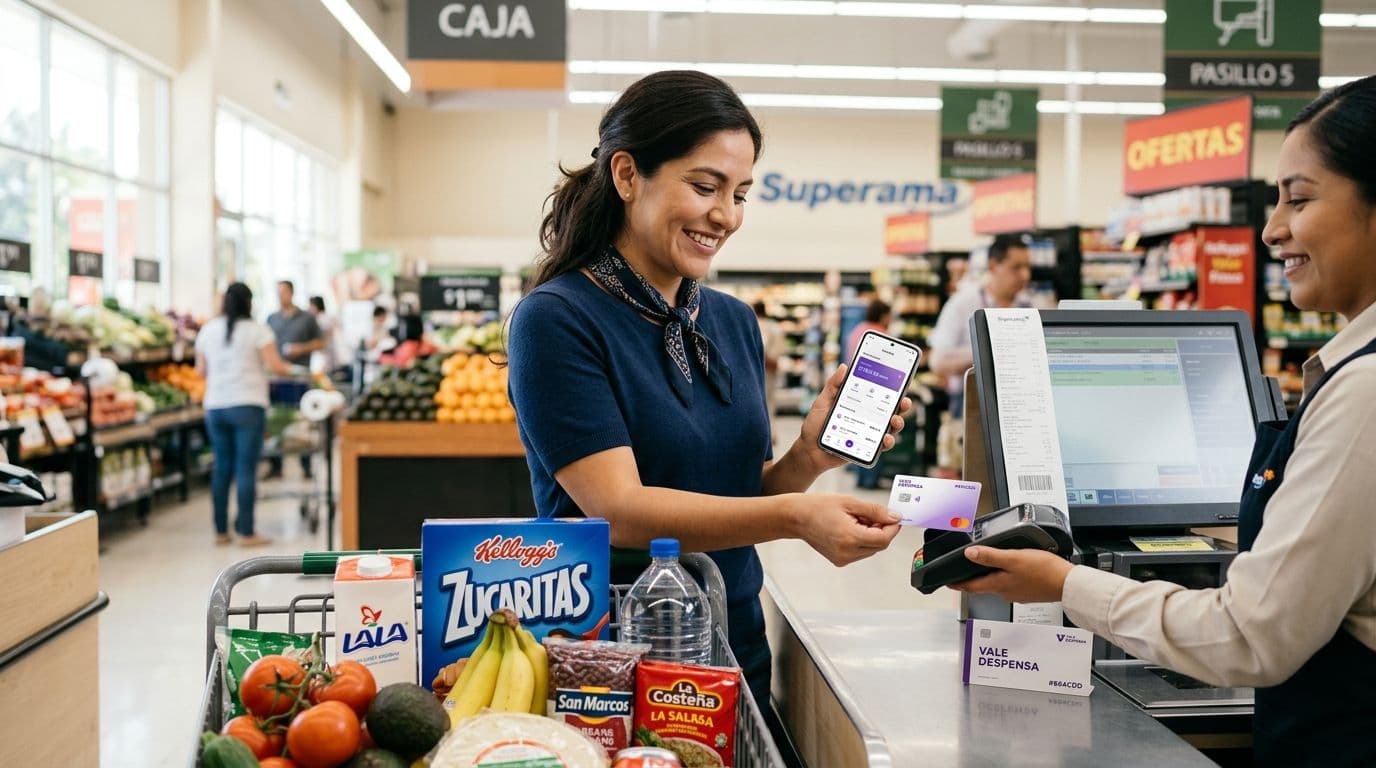
Unlike a direct salary increase, a grocery voucher cannot be exchanged for cash or withdrawn as money: it is limited to a specific use. That very restriction is what unlocks the tax benefit. In practice, vouchers today are not paper slips but a balance loaded onto a card or electronic wallet authorized by the SAT, which the employee uses at supermarkets and affiliated stores.
It is important to distinguish the grocery voucher from other arrangements. It is not a productivity bonus (which is taxed as income), it is not a travel allowance, and it is not a generic social-welfare benefit: it is a benefit with its own rules, tied to grocery spending and conditional on the use of authorized electronic means.
What tax benefits do they have for the company and the employee?
The appeal of grocery vouchers lies in their tax treatment, which works on three distinct fronts that should not be confused.
Deductibility for the company (income tax / ISR). Grocery vouchers are deductible from corporate income tax (ISR) within the limits that the Income Tax Law sets for benefits that are tax-exempt income for the employee. In general terms, the exempt portion of benefits is only partially deductible; the applicable criterion depends on whether the company maintains or reduces benefits versus the prior year. That is why it is essential to confirm the current percentage with an accountant or tax adviser before budgeting.
Income-tax exemption for the employee. For the recipient, grocery vouchers are exempt from income tax up to a cap tied to the UMA (Unidad de Medida y Actualización, Mexico's reference unit). This means that, up to that limit, the employee receives the full benefit with no tax withheld — unlike an equivalent raise paid in cash.
Exclusion from the IMSS contribution base. Independently of income tax, the Social Security Law allows grocery vouchers to be excluded from the contribution salary base as long as they do not exceed 40% of one UMA. Above that share, the excess is integrated into the base salary and generates contributions. This 40%-of-UMA figure is an IMSS limit, not the income-tax deductibility limit: conflating the two is one of the most common mistakes.
The combination of these three elements is what makes a peso delivered as vouchers stretch further than a peso delivered in cash, for both the company and the employee. It is the same principle behind flexible benefits: structuring compensation to maximize real income without proportionally inflating the tax burden.
How are they calculated and how much should you provide?
There is no mandatory amount for grocery vouchers: each company decides how much to provide based on its compensation policy, its budget, and its labor-market reality. What does exist are the caps that determine how far the benefit keeps its tax advantage.
The calculation starts from the current UMA, which INEGI updates each year. The two relevant caps are different: the income-tax exemption limit for the employee, and the 40%-of-UMA limit for exclusion from the IMSS base. Because the UMA changes annually, any exact peso figure goes stale fast; the sensible approach is to compute both caps using the current year's UMA value and set the amount within that margin.
In practice, many companies set the voucher near the limit that preserves the full tax benefit, because going beyond that point means starting to pay contributions and taxes on the excess — that is, losing efficiency. The real decision is not purely numerical: it means balancing tax savings with what actually moves employee satisfaction. An amount that barely covers a symbolic purchase has little impact; a well-calibrated amount noticeably improves monthly purchasing power.
A candid way to frame it: the grocery voucher optimizes the cost of a benefit, but it does not guarantee that this benefit is the one each employee values most. That distinction is what opens the conversation about flexibility later on.
How are they delivered? The SAT-authorized electronic wallet
To preserve the tax benefit, grocery vouchers must be delivered through an electronic wallet authorized by the SAT. They cannot be paid in cash, they cannot be redeemable for money, and they cannot be withdrawn from ATMs. This is a condition, not a recommendation: if the benefit is paid in cash, it loses both the income-tax exemption for the employee and the deductibility for the company.
A SAT-authorized electronic wallet is a card — physical or digital — issued by a company that holds authorization from the Tax Administration Service (Servicio de Administración Tributaria) to operate this type of benefit. The SAT publishes the registry of authorized issuers, and only vouchers channeled through them generate the tax receipts (CFDI) that support the deduction. The issuer also restricts the balance to permitted categories (supermarkets, groceries, food stores), ensuring the benefit is used for its purpose.
In practice this carries an operational component: the company contracts an authorized issuer, loads the balances month by month, and manages onboarding, offboarding, and reporting. Part of choosing a provider comes down to how convenient that operation is, the acceptance network, and the quality of the administration platform — not just the voucher amount.
What can grocery vouchers be used for?
Grocery vouchers are designed for buying food and basic-basket products: groceries, packaged goods, household cleaning and hygiene products, and everyday supermarket spending in general. The exact scope depends on the issuer and the categories enabled across its network of affiliated stores.
The limits are clear by design too: they cannot be used to withdraw cash, they cannot be transferred to a bank account, and — depending on the issuer — they typically exclude certain categories such as alcohol, tobacco, or restaurant spending. This restriction is deliberate; it is what keeps the benefit within the framework that gives it its tax treatment.
For the employee, the real value is direct: the balance covers spending they were going to make anyway, freeing up income for other purposes. For the company, the value lies in delivering that relief efficiently. The natural question that follows is whether groceries are always the spending that helps each person most — and that is where the conversation about flexible benefits begins.
Beyond the traditional voucher: when a flexible benefit makes sense
The grocery voucher solves a narrow problem well: providing purchasing power for one type of spending, with tax efficiency. Its limitation is precisely that rigidity. A young person with no dependents, an employee with school-age children, and someone close to retirement have very different needs, and a voucher that only works for groceries does not fit all three situations equally.
A flexible benefit starts from the same tax-efficiency logic but broadens the decision: instead of a rigid balance earmarked solely for groceries, the employee receives a budget they can allocate across the categories that serve them best — groceries, health, education, transport, wellbeing, or shopping — through a single card or platform. The company keeps control of the budget and the tax structure; the employee gains relevance and freedom of choice.
The effect on adoption is concrete. When a benefit feels personally relevant and useful, it gets used more and valued more; when it arrives as a generic allocation, its impact on satisfaction fades. That is why many companies that started with grocery vouchers are migrating toward flexible schemes — not to replace groceries, but to fold them into a broader menu the employee shapes around their stage of life. In practice, a flexible-benefits platform can bring groceries, retail discounts, and other categories together in one place, adding a discount and voucher club that stretches purchasing power beyond the loaded balance.
The choice between a traditional voucher and a flexible benefit is not ideological — it is about fit. If the priority is solving a single expense with maximum operational simplicity, the voucher does the job. If the priority is for the benefit to genuinely move satisfaction and retention across a diverse workforce, flexibility delivers more for the same budget. To go deeper into how that kind of program is structured, it helps to review what a corporate benefits club is and how it integrates with the benefits the company already provides.
Grocery vouchers will remain a relevant piece of compensation in Mexico because they efficiently solve a real problem. The question for HR is not whether to use them, but how to fit them into a total-compensation strategy that feels personalized and that employees actually take advantage of. Maslow brings flexible benefits, discounts, and recognition together on a single platform, precisely because a benefit works better when the employee decides how to use it.
Frequently asked questions about grocery vouchers
What are grocery vouchers?
They are a benefit that companies in Mexico provide to their employees to buy food and basic-basket products. They are delivered as a balance on a SAT-authorized electronic wallet, supplement salary, and receive preferential tax treatment when the relevant rules are met.
How are grocery vouchers calculated?
There is no mandatory amount; each company sets it based on its compensation policy. What does exist are caps tied to the UMA: the income-tax exemption limit for the employee and the 40%-of-UMA limit for exclusion from the IMSS base. Since the UMA is updated each year, both caps should be calculated using the current value.
What tax benefit do they have for the company?
Grocery vouchers are deductible from corporate income tax within the limits the law sets for the employee's exempt benefits, and they allow up to 40% of one UMA to be excluded from the IMSS contribution base. The exact deductibility percentage depends on the rules in force, so it should be confirmed with an accountant.
Can grocery vouchers be paid in cash?
No. To preserve the tax benefit, vouchers must be delivered through a SAT-authorized electronic wallet and cannot be redeemable for money or withdrawn as cash. Paying them in cash eliminates both the income-tax exemption for the employee and the deductibility for the company.
What is a SAT-authorized electronic wallet?
It is a physical or digital card issued by a company authorized by the Tax Administration Service to operate grocery vouchers. Only vouchers channeled through these issuers generate the tax receipts (CFDI) that support the deduction, and the balance is restricted to grocery categories.
What can grocery vouchers be used for?
For buying food and basic-basket products: groceries, packaged goods, household cleaning and hygiene, at supermarkets and stores affiliated with the issuer's network. They cannot be used to withdraw cash and usually exclude categories such as alcohol, tobacco, or restaurants depending on the issuer.
What is the difference between traditional grocery vouchers and a flexible benefit?
The grocery voucher is a rigid balance earmarked only for groceries. A flexible benefit keeps the tax efficiency but lets the employee allocate a budget across several categories — groceries, health, education, transport, and more — from a single platform, which improves adoption and satisfaction compared with a single fixed allocation.
---
This guide is for informational purposes and does not constitute tax, legal, or accounting advice. SAT rules, deductibility percentages, and the value of the UMA change periodically; always verify the current UMA value published by INEGI and consult your accountant or tax adviser before making compensation decisions.
How Maslow solves it
Explore the product related to this topic:


